
Help center
Thank you for choosing Ting! Bringing Lightspeed fiber internet to your home or business is a straightforward process, but like any new utility, it does require a bit of work to get everything set up. Before we walk through the installation steps, here's a quick primer on how fiber internet actually works and why some digging is involved.
Unlike traditional cable or DSL, which send your internet signal as electricity through copper wire, fiber internet sends it as pulses of light through thin strands of glass. Each strand is roughly as thin as a human hair, bundled together inside a protective cable that's not much bigger than a garden hose. That's a lot of capacity packed into something surprisingly small.
Because the signal travels as light rather than electricity, fiber can carry data faster and over longer distances with far less signal loss than older copper-based connections.
.webp)
Ting buries fiber underground wherever possible, and there's a practical reason for it: buried cable is shielded from wind, ice, falling branches, and everyday weather. Fewer things exposed to the elements means fewer outages down the road.
In some areas, running cable overhead on utility poles makes more sense depending on the terrain and existing infrastructure, but underground is generally the more reliable option. This means in order to have Ting internet we need to do a bit of digging on your property prior to your installation appointment.

The fiber cable itself doesn't go directly into the ground. It's threaded through a conduit, a protective plastic pipe that shields it from moisture, shifting soil, and general wear and tear. This conduit is typically buried at least 18–24 inches deep.

Before any digging starts, crews mark existing underground utilities with colored flags so they know what's already down there. You may notice orange (telecom/cable), blue (water), or yellow (gas) markings, this is standard practice anytime construction happens near buried lines, sometimes called an "811 locate."
This is also why we ask you to mark any private lines on your property, like sprinkler systems or invisible fences, that wouldn't show up in a public utility locate.
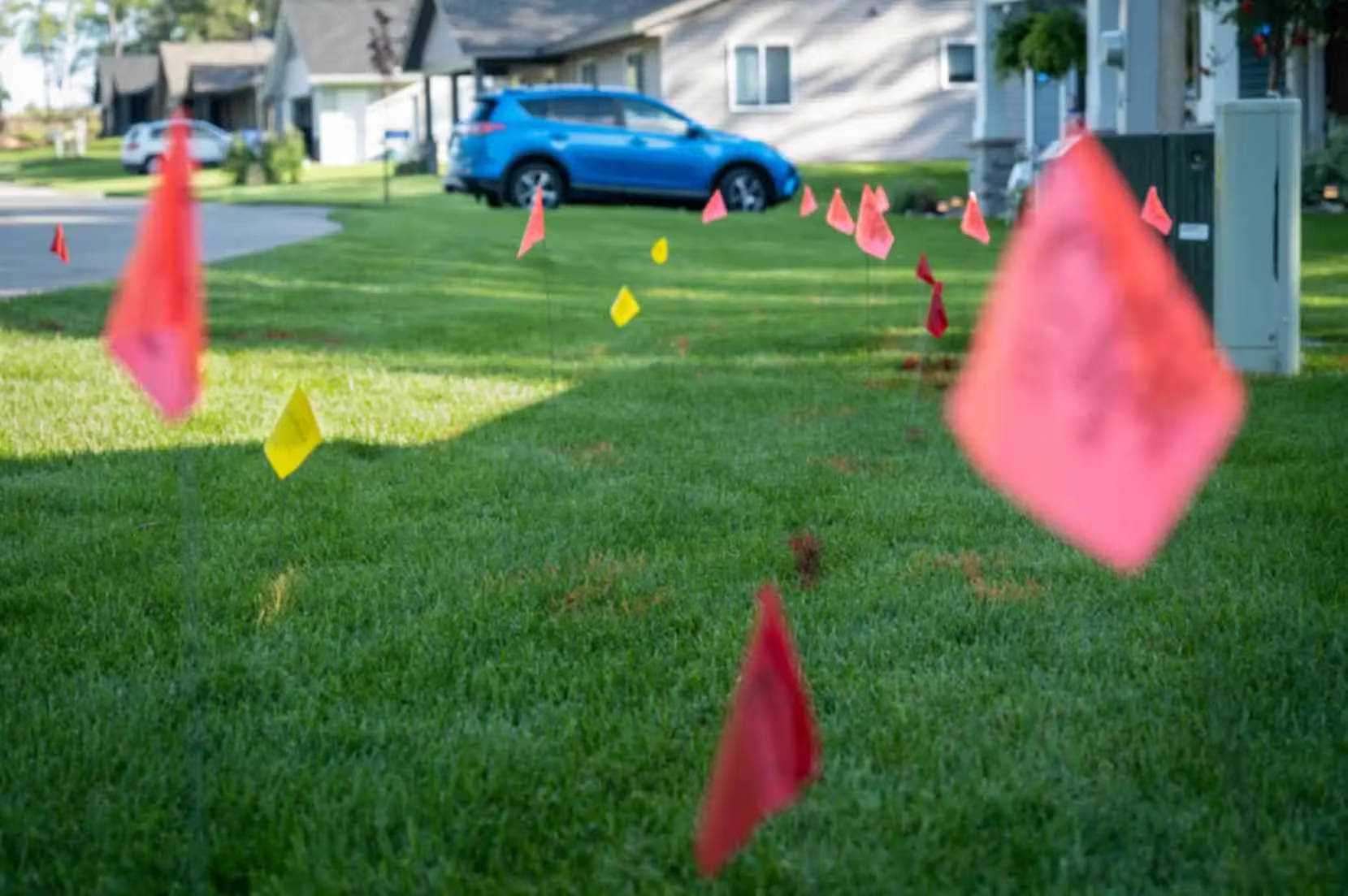
This is when a crew visits your property to mark underground utilities as mentioned above.
If you have any private underground lines, you'll need to mark those yourself before construction starts. Ting isn't able to take responsibility for damage to private utilities that haven't been marked, so this step matters.
Once utilities are marked, our contractors return to begin construction. Here's what they'll do:
Next comes your scheduled home installation. On this day, a Ting technician will install your ONT (Optical Network Terminal) — think of it as your fiber modem — inside your home.
To connect the ONT to the outdoor utility box (NID), the technician will drill a small hole, about the size of a nail, through your exterior wall. Before wrapping up, they'll confirm your service is online and working properly. At that point, you're all set to enjoy fast, reliable Ting internet.
We book home visit appointments for two to two and a half hours, but most people only need about one hour. However, the time is yours to ask any questions or explore options!
Our Ting technician installs the NID for the fiber to enter your home and the ONT that connects to your router. Whether you are using a Ting router or your own router, the Ting technician can help with some basic setup.
The Ting Fiber access point should always be the best place to bring Ting fiber into your home to give you the best experience.
Aim for a central location in close proximity to the majority of devices that will access the service. An ideal situation is where the wired connection is easily accessible to your devices that need the consistency of a wired connection while also allowing your wireless devices close proximity to the wireless router for a consistent connection.
If the ideal location doesn't fit the parameters for your ideal location, we've got you covered! A custom installation may be for you.